


Genomic testing has been evolving quickly over the past two decades. It has become increasingly less expensive and more informative to genotype animals.
Genomic, test results are used to enhance predictability of current selection tools, to achieve more accuracy on EPDs for younger animals, and to characterize genetics for traits that are difficult or expensive to measure, such as feed efficiency, carcass traits in breeding stock or maternal traits in bulls. With the investment in genomic technology, animals who were previously placed into single animal contemporary groups now benefit by receiving GEPDs, rather than interim EPDs .
Genomic testing is one more tool for breeders to use to more accurately predict the future performance of animals as parents in the population, but this is not a replacement to performance data recording. Breeders sometimes ask if it is no longer necessary to collect weights and measures (e.g. weaning weights, ultrasound scan data, or carcass data, and heifer breeding records). On the contrary, phenotypic measures continue to be an important part in further development of improved genomic panels and the refinement of this technology over time. Genomically enhanced EPDs (GEPDs) are important because they utilize genomic test results in addition to pedigree, performance and progeny data for increased reliability of an animal’s EPD.
Angus GS Test
Angus GS stands for Angus Genomic Selection. This name reflects the aim of the test to give Angus breeders and their customers a tool designed to guide whole-herd selection, mating management and breed-improvement decisions, as well as denoting the value of seedstock cattle. Ordering the Angus GS test is exactly the same process as ordering any other DNA test.
- GEPDs – higher accuracy
- GEDPs – on cattle with no phenotype
- On older cows
- On new imports
- On young animals
- On animals purchased from non-performance herds
- GEDPS – on traits where no phenotype
- GEPDs for Carcass quality traits
- GEPDs for HIR
- GEPDs for RFI
- The Canadian Balance Index
- Parentage Verification
- Genomic Percentile Ranks
Plan Ahead!
It’s important to plan for when you will want your Angus GS test results. The test turnaround time from when the sample arrives at the lab is 21 calendar days (lab staff work through weekends).
The deadline for data going into our monthly AngusONE genetic evaluation is the 15th of the month. The results of the genetic evaluation will be posted after the first weekend of the following month.
For example, if you submit your request on January 1st, the next genetic evaluation would be the February evaluation, so the results would be received well in time for the February 15 deadline. The results of that genetic evaluation would be published on March 2.

If you need your Angus GS test results back for a specific date, please plan ahead. You can see from this timeline you will need to request the test and submit your samples well in advance.
For additional information, please view the video Angus GS, Genomic Percentile Ranks, and GEPDs on our Angus Broadcasting Canada (ABC) channel.
Singlestep Genetic Evaluations
Singlestep methodology for our genetic evaluations allow us to us genomic information to strengthen the pedigree matrix in the evaluations. Based on traditional pedigree information a set of full sibs would be related by 50% and the relationship between a grandparent animal and its grandprogeny would be 25%. However, we know that some full sibs are more similar to eachother, and some are not. Genomic technology allows us to accurately describe the degree of relatedness between animals that are genotyped. Thus, strengthening our genetic evaluations, and making them more accurate than ever before.
Understanding and using EPDs and Genomic Technology
Expected progeny differences (EPDs) are genetic selection tools that provide producers a measure of an animal’s genetic merit for traits that are economically relevant to their operation. Basically, EPDs are a measure of how an animal’s progeny can be expected to perform, on average.
An animal’s genetics will contribute in part to how it performs. A portion of that performance is also dictated by the environment provided to that animal. The environment includes weather, disease, feed, stress, handling, vaccination protocols, maternal environment, housing, and the animal group dynamics. The environment differs for each herd as geography and producer management plays a large role in environment. EPDs remove the environment from all traits measured and provide producers with an estimate of the genetics that contribute towards each trait.
EPDs are:
- A prediction of how an animal’s
progeny will perform - A genetic selection tool
- Used to compare animals across
different environments
Genomics are:
- Used to parent verify animals for guaranteed pedigrees
- Used to calculate EPDs for animals that don’t have a phenotype for a particular trait
- Used to calculate more accurate EPDs, especially for younger animals
- Used to calculate EPDs for new and expensive to measure traits, like High Immune Response
How are EPDs calculated?
EPDs describe how the progeny of an animal will perform for a specific trait. EPDs are calculated using pedigree information, individual performance information, progeny performance information, and genomic information.
The Canadian Angus Performance Program is based on whole herd reporting. Participants on the program are required to report complete cow herd inventory information (a calf or a fate or cull code for each cow in your inventory), and a birth weight and weaning weight on every calf. Complete contemporary group information is vital for the calculation of accurate EPDs. In addition, accurate management group recording is vital for the calculation of accurate EPDs. Members should place all calves that were managed the same way, and given the same opportunity to develop the trait being reported in one management group. Any calves treated differently, for example, any calves fed extra or calves that were sick should be placed in separate management groups.
Why is EPD accuracy important?
EPDs should always be published with an estimate of accuracy. This informs producers of the amount of information available with which to calculate the EPD. P or P+ EPDs or estimates are low in accuracy. As more information becomes available, EPD accuracy will grow from 0 to 100%.
Using EPDs
EPDs are comparative numbers. This means that the easiest way to use EPDs is to compare a bull’s EPDs to another bull’s EPDs. For example:
Bull A has a Yearling Weight EPD = 150 lbs
Bull B has a Yearling Weight EPD = 100 lbs
On average Bull A’s calves will weigh 50 lbs heavier than the average of Bull B’s calves given the same cow herd and environment. Another way to use EPDs is to compare to the breed average. This is useful to producers who know the breed and what to expect in terms of performance from the breed. For example, the average calving ease for Canadian Angus genetics is very different from the average calving ease of other breeds. In Angus the average is a lot of calving ease!
What is Angus GS?
Angus GS is a newer version of the Bovine 50K panel that we used to use. It’s specifically designed for Angus genetics. It has all the same SNP markers that the 50K panel has on it, and more. There is a lot of value on genomic technology, specifically the Angus GS test.
Angus GS includes:
- SNP Parentage Verification
- Genetic condition test results are available for reduced fees than doing the test(s) individually
- Genomic percentile ranks
- GEPDs (more accurate genomically enhanced
EPDs)
What role does genomics, and the Angus GS panel play?
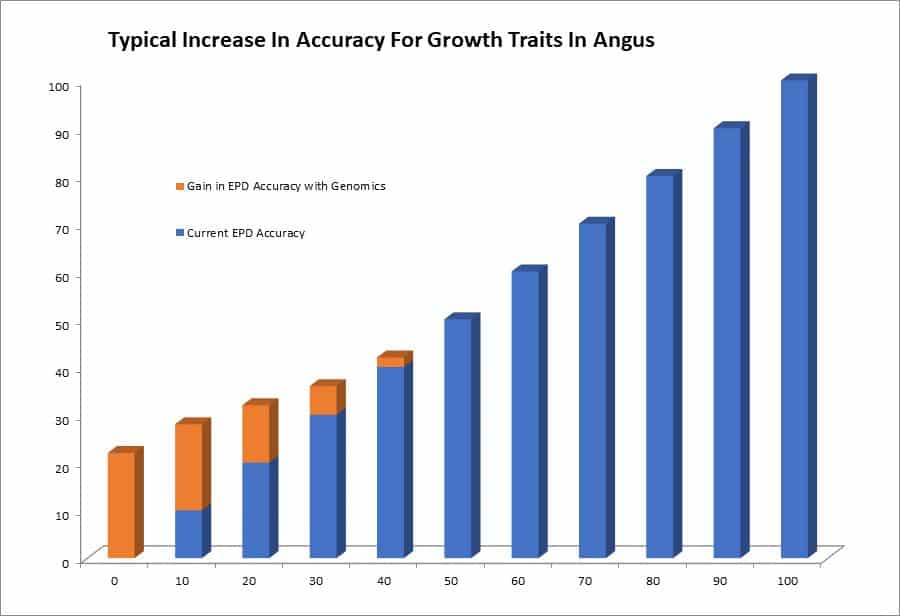
Genomic technology has been used to make EPDs more accurate. The genomic data increases the accuracy with which we relate animals to each other, verifying pedigree information, and allowing us to apply phenotypes of related animals to non-phenotyped animals.
Genotyping animals has led to more accurate EPDs for younger animals. Below are the progeny equivalents that come from the Angus GS panel. This means that doing the Angus GS test on an animal gives you as much information as having 23 calves with birth weights recorded and as many as 12 calves tested for individual feed intake.
| Trait | Progeny Equivalent | Trait | Progeny Equivalent |
|---|---|---|---|
| Calving Ease | 26 | Claw | 10 |
| Birth Weight | 23 | Fertility | 17 |
| Weaning Weight | 27 | Milk | 36 |
| Yearling Weight | 23 | Mature Weight | 15 |
| Dry Matter Intake | 12 | Marbling | 11 |
| Docility | 12 | Rib Eye Area | 14 |
| Feet | 10 | Teat and Udder | 12 |
EPDs: are a universal way of describing the genetic potential of progeny from breeding stock
EPDs: are a genetic selection tool that can help producers reach a breeding selection goal for their her
EPDs: can help you maintain the traits that you want to keep in your herd
EPDs: can help you avoid traits that you might not wish to use on your cow herd and introduce into your herd
EPDs: are a great way to describe the high quality Canadian Angus genetics that you raise to your customers
EPDs: are the only fair way to compare breeding stock across herds and different environments
Working Together
The American Angus Association and the Canadian Angus Association use a custom made SNP (single nucleotide polymorphisms) genomic panel called Angus GS. This is a high density 80,000 (80K) SNP marker panel. The results from this genomic test (an animal's genotype) is incorporated into our monthly genetic evaluations to enable us to generate more accurate EPDs, as well as EPDs for animals that might not yet have been phenotyped for a specific trait.
Genomic Percentile ranks (1-100) are also provided to members to assist in establishing direction of interest for each trait. The Angus GS test results are also incorporated into our evaluation using singlestep methodology to calculate GEPDs. Incorporating genomic results in this way helps to better define the genetic relationship among animals.
If you are making selection decisions for traits that have a GEPD provided by the Association, then the GEPDs should be considered the selection tool of choice.